Week 01 · Populations, samples, and statistics
Estimate a fixed population rate and explain why two samples disagree.
Estimate a fixed population rate and explain why two samples disagree.
Work through the problem
Suppose every request in a stable system independently has probability p = 0.30 of retrying. The population model describes all possible requests. One sample is a finite set of observed outcomes. The parameter p is fixed in this model. The statistic p̂ is computed from the sample and changes when the sample changes.
With five requests [1, 0, 0, 1, 0], p̂ = (1 + 0 + 0 + 1 + 0)/5 = 0.40. For a random sample of size n, linearity of expectation gives E[p̂] = (np)/n = p. An unbiased estimator can still miss in either direction on a particular day. If requests share an incident, the independent model may understate the variation.
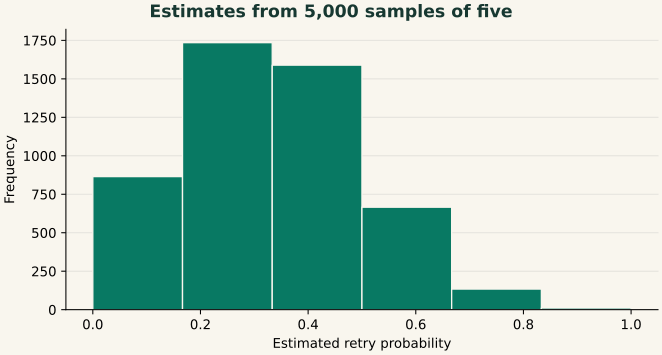
Estimates from 5,000 samples of five.
Run the Python lab
import numpy as np
rng = np.random.default_rng(12)
p = .30
rates = rng.binomial(1, p, size=(5000, 5)).mean(axis=1)
print("Observed estimate:", np.mean([1, 0, 0, 1, 0]))
print(f"Mean across samples: {rates.mean():.3f}")
assert abs(rates.mean() - p) < .02
Output from the lab
Observed estimate: 0.4
Mean across samples: 0.300
Practice
- In a sample with three retries out of ten, what are the parameter and statistic?
Check your reasoning
- The model parameter remains 0.30. The observed statistic is also 0.30 in this particular sample.