Week 10 · Random walks and first passage
Measure the probability of reaching capacity by a deadline.
← Week 9 · Subject contents · Week 11 →
Measure the probability of reaching capacity by a deadline.
Work through the problem
A buffer changes by +1 or −1 each minute with equal probability. Let T be the first minute it reaches level 3, starting at 0. The event T ≤ n is equivalent to the running maximum by minute n reaching 3. Checking only the last value misses paths that already reached 3 and came back down.
The earliest possible hit is at minute 3, with probability (1/2)³ = 1/8. Simulate a longer window, recording runs without hits as censored. The fraction of hits by the horizon estimates a probability. The mean among only completed hits does not give the unconditional mean.
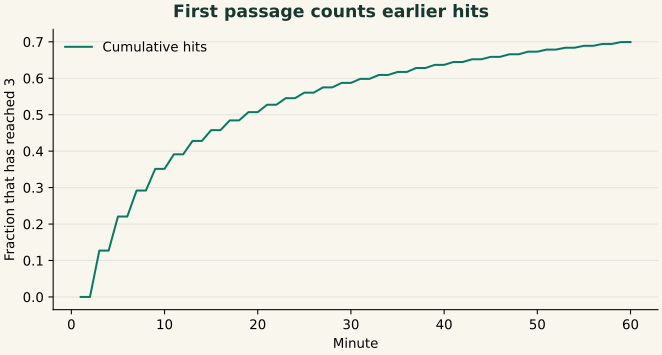
First passage counts earlier hits.
Run the Python lab
import numpy as np
steps = np.random.default_rng(5).choice([-1,1], (15000,60))
walks = steps.cumsum(1)
ever = np.maximum.accumulate(walks, axis=1) >= 3
curve = ever.mean(axis=0)
print("Hit by minute 3:", round(curve[2],3))
print("Hit by minute 60:", round(curve[-1],3))
print("At or above 3 at minute 60:", round((walks[:,-1]>=3).mean(),3))
assert abs(curve[2]-.125) < .02
Output from the lab
Hit by minute 3: 0.127
Hit by minute 60: 0.699
At or above 3 at minute 60: 0.349
Practice
- Can the cumulative hit probability decrease with time?
Check your reasoning
- No. A path counted as having hit stays counted even when it moves down.