Week 02 · Discrete dynamical systems
Predict whether a small perturbation shrinks near a fixed point.
← Week 1 · Subject contents · Week 3 →
Predict whether a small perturbation shrinks near a fixed point.
Work through the problem
The logistic map xₜ₊₁ = r xₜ(1−xₜ) models a normalized population under density limits. A nonzero fixed point satisfies x* = r x*(1−x*), hence x* = 1−1/r. A perturbation δ near this point changes approximately by f′(x*)δ = (2−r)δ per step.
At r = 2.5 the multiplier is −0.5, so a small disturbance alternates sides and shrinks. At r = 3.2 the multiplier is −1.2, so the same local perturbation initially grows. This argument applies close to the fixed point.
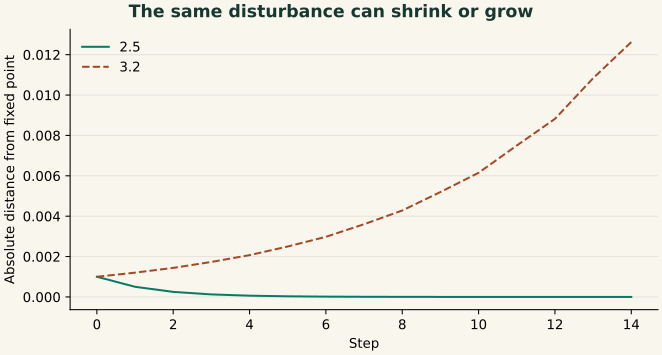
The same disturbance can shrink or grow.
Run the Python lab
import numpy as np
paths = {}
for r in [2.5, 3.2]:
    fixed = 1-1/r
    x = fixed + .001
    delta = [x-fixed]
    for _ in range(14):
        x = r*x*(1-x)
        delta.append(x-fixed)
    print(r, f"first ratio {delta[1]/delta[0]:.3f}")
    assert abs(delta[1]/delta[0] - (2-r)) < .004
    paths[str(r)] = np.abs(delta)
Output from the lab
2.5 first ratio -0.502
3.2 first ratio -1.203
Practice
- What does a negative multiplier indicate?
Check your reasoning
- A sufficiently small positive disturbance becomes negative at the next step.