Week 12 · Capstone · Diagnose a neural network with an ablation
Train a nonlinear model and reproduce a failed run with one change.
Train a nonlinear model and reproduce a failed run with one change.
Work through the problem
Classify the signs of two inputs using XOR. The classes occupy alternating quadrants. A single linear decision boundary cannot separate all four. A hidden layer with a nonlinear activation can combine several linear regions. Removing the activation leaves a composition of affine maps, which is still affine.
Train the same architecture twice with identical weights, data, optimizer and update budget. Change only whether ReLU is active. Report held-out accuracy, inspect the loss curves, and include a failed case near a quadrant boundary. The exercise tests one architectural hypothesis on one data distribution.
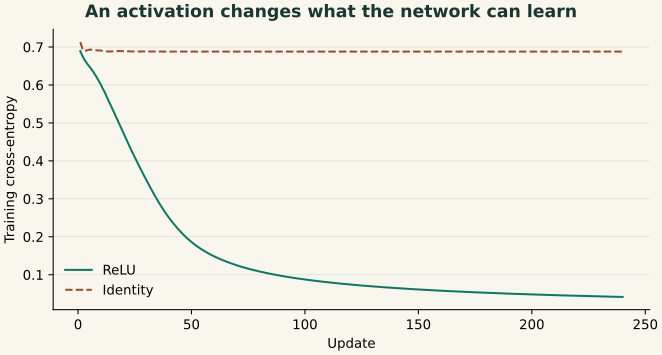
An activation changes what the network can learn.
Run the Python lab
import torch
from torch import nn
torch.set_num_threads(1)
torch.manual_seed(33)
X = torch.rand(640,2)*2-1
y = ((X[:,0]>0) ^ (X[:,1]>0)).float()
curves, accuracy = {},{}
for name, activation in [("ReLU",nn.ReLU()),("Identity",nn.Identity())]:
    torch.manual_seed(16)
    model = nn.Sequential(nn.Linear(2,12),activation,nn.Linear(12,1))
    opt = torch.optim.Adam(model.parameters(),lr=.03)
    trace = []
    for _ in range(240):
        opt.zero_grad()
        loss = nn.functional.binary_cross_entropy_with_logits(model(X[:480])[:,0],y[:480])
        trace.append(loss.item())
        loss.backward()
        opt.step()
    pred = model(X[480:])[:,0]>0
    accuracy[name] = (pred==y[480:]).float().mean().item()
    curves[name]=trace
    errors = X[480:][pred!=y[480:]]
    print(name,round(accuracy[name],3),"closest mistaken inputs:",errors[errors.abs().min(dim=1).values.argmin()].tolist() if len(errors) else [])
assert accuracy["ReLU"] > accuracy["Identity"] + .2
Output from the lab
ReLU 0.988 closest mistaken inputs: [-0.0063468217849731445, -0.7321820259094238]
Identity 0.494 closest mistaken inputs: [0.4903963804244995, 0.0010576248168945312]
Practice
- Why can the linear run still do better than random on one finite split?
Check your reasoning
- A line can classify some quadrants and the empirical class balance fluctuates. Compare the observed gap with more seeds and test samples.
Further reading · Goodfellow, Bengio, and Courville · Deep Learning